
By Felipe Dorta, Financial Content Editor
Last Updated: March 13, 2026 | Originally Published: March 13, 2026
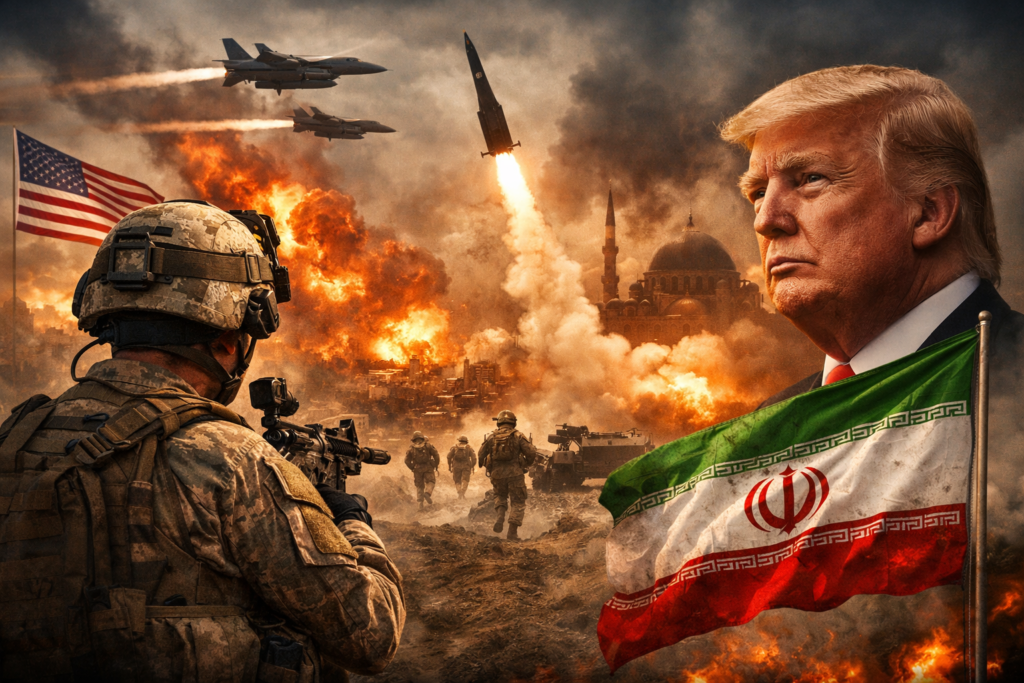
President Donald Trump has privately expressed serious interest in deploying U.S. ground troops inside Iran, according to multiple U.S. officials and sources familiar with the conversations a dramatic escalation that would transform the current air campaign into a full-scale military occupation with profound implications for markets, global security, and American foreign policy.
The revelation comes as Operation Epic Fury enters its second week, with six U.S. service members already killed and 18 wounded in Iranian counterattacks. While the administration publicly maintains that ground forces are “not part of the plan right now,” Trump’s private discussions reveal a president actively considering options that would place American boots on Iranian soil for the first time since the 1979 hostage crisis.
Critical Development: Secretary of State Marco Rubio told Congress that securing Iran’s highly enriched uranium stockpile will require ground forces, stating bluntly: “People are going to have to go and get it.” The 440kg of weapons-grade material—enough for at least 10 nuclear warheads represents the war’s most urgent strategic threat.
The Mission: Securing Iran’s Nuclear Material
The primary objective under consideration is not regime change or occupation, but a targeted operation to locate and neutralize Iran’s highly enriched uranium (HEU) stockpile—the core element of Tehran’s nuclear weapons capability.
Target Facilities
Table:
| Facility | Location | Depth/Protection | Material Stored |
|---|---|---|---|
| Natanz | Central Iran | New fortified underground facility “Pickaxe Mountain” | Unknown quantity HEU |
| Isfahan | Western Iran | Deep tunnels, heavily defended | ~200kg HEU (IAEA confirmed) |
| Fordow | Near Qom | Mountain-bunkered enrichment plant | Enrichment infrastructure |
The uranium hexafluoride—solid at room temperature, gaseous when heated—is stored in metal canisters roughly the size of scuba tanks, buried in deep shafts beneath reinforced concrete and mountain rock.
Operational Concept
Military analysts outline a phased approach:
Phase 1: Air Supremacy Suppress Iranian air defenses to establish uncontested airspace for transport and support aircraft.
Phase 2: Rapid Insertion Deploy 82nd Airborne Division to secure airfields and staging areas—the same unit used in WWII, Afghanistan, and Iraq invasions.
Phase 3: Special Operations Navy SEALs and Army Special Forces conduct precision raids on hardened facilities, locate nuclear materials, and establish security perimeters.
Phase 4: Extraction Mobile Uranium Facility equipment specially designed C-17 transportable systems—contain and remove HEU, followed by rapid troop withdrawal.
“This would be tough. It is pretty well defended and it’s large and bulky, so you’re not going to just go in and pick it up,” warns Jeffrey Lewis, nuclear proliferation expert at Middlebury Institute of International Studies.
Trump’s Strategic Vision: The Venezuela Model
Trump has privately described his ideal outcome as mirroring the U.S.-Venezuela dynamic since American special forces captured Nicolás Maduro in January 2026 a scenario where the U.S. backs new leadership under conditions favorable to American interests, including cooperative oil production.
The president told aides he envisions a post-war Iran where:
- Uranium stockpiles are secured or removed
- A new Iranian regime cooperates with U.S. energy policy
- Oil production stabilizes global markets
- Regional security architecture is reshaped
“I don’t have the yips with respect to boots on the ground,” Trump stated in a New York Post interview. “I say ‘probably don’t need them,’ [or] ‘if they were necessary.'”
However, the White House maintains strategic ambiguity. Press Secretary Karoline Leavitt emphasized that while Trump “always, wisely keeps all options open,” no decisions have been made and critics “have no real seat at the table.”
Congressional Alarm: “On a Path to Ground War”
Democratic lawmakers emerged from classified briefings expressing grave concern about administration intentions.
Senator Richard Blumenthal, after attending a Senate Armed Services Committee briefing, stated: “I am left with more questions than answers… I am most concerned about the threat to American lives of potentially deploying our sons and daughters on the ground in Iran. We seem to be on a path toward deploying American troops on the ground in Iran to accomplish any of the potential objectives here.”
Senator Chris Murphy noted that while officials claimed the goal was destroying Iran’s military assets, “they could not detail any long-term plan”—raising fears of mission creep without clear exit criteria.
Public Opinion: A Quinnipiac University poll shows 74% of Americans oppose deploying ground troops to Iran, with only 25% approving of the war itself according to a Reuters-Ipsos survey conducted after hostilities began.
Iran’s Response: “We Are Waiting for Them”
Iranian leadership has responded to ground invasion threats with defiance rather than deterrence.
Foreign Minister Abbas Araghchi told NBC News: “We are waiting for them… we are confident that we can confront them, and that would be a big disaster for them. We have prepared ourselves to confront with any scenario.”
The IRGC spokesperson Ebrahim Zolfaqari explicitly threatened economic retaliation: “Get ready for oil to be $200 a barrel, because the oil price depends on regional security, which you have destabilised.”
Iran’s military strategy focuses not on conventional victory but on political endurance inflicting sufficient economic pain and regional instability to force American withdrawal. This approach has already demonstrated effectiveness:
- Closure of Strait of Hormuz (20% of global oil supply)
- Attacks on shipping and energy infrastructure across six Gulf nations
- Disruption of LNG supplies to energy-dependent Asian markets
- Activation of proxy networks (Hezbollah, Houthis) for asymmetric warfare
The Escalation Trap: Historical Precedents
Foreign policy experts warn that “limited” ground operations often expand into protracted conflicts.
The Iraq Precedent (1990-2003)
The U.S. imposed no-fly zones over Iraq throughout the 1990s ostensibly a limited aerial containment strategy. This “permanent aerial occupation,” as Foreign Affairs describes it, “only set the stage for the 2003 U.S. ground invasion” without achieving political control.
The Afghanistan Model
Two decades of “counter-terrorism” operations evolved into nation-building, with special forces raids expanding to sustained ground presence.
Risk Factors in Iran
- Geographic Scale: Iran is four times larger than Iraq with mountainous terrain
- Population: 87 million people vs. Iraq’s 25 million (2003)
- Military Capacity: Sophisticated missile forces, cyber capabilities, proxy networks
- Nationalist Mobilization: Historical precedent shows external attacks can unify opposition to the regime behind nationalist sentiment, as occurred during the 1980s Iran-Iraq War
Military Analysis: Can It Be Done?
Analysts offer divergent assessments of mission feasibility:
The Optimistic View Joel Rayburn, former Trump administration official at Hudson Institute: “You could envision them doing some sort of special operations insertions if there were targets that they absolutely needed to take out… That’s the kind of thing where you do an insertion, you attack a target, or conduct a raid, and then you get out.”
The Skeptical Assessment Neil Quilliam, Chatham House: “A US ground mission… could be risky and is likely to trigger a severe response from Tehran… These would be high-risk, complex and lengthy operations taking place in very hostile environments and against facilities heavily protected by the country’s security forces.”
The Technical Challenge Matthew Bunn, Harvard Kennedy School: “It is just shocking to launch a military operation like this, justified by the nuclear danger, and not have a plan for dealing with the most urgent part of the nuclear danger.” The administration launched strikes without apparent planning for HEU extraction a failure critics call strategically negligent.
Economic and Market Implications
The mere consideration of ground troops has intensified market volatility:
Table:
| Asset Class | Pre-Ground Troops News | Post-Revelation | Change |
|---|---|---|---|
| Brent Crude | $101.15 | $108.50 | +7.3% |
| VIX (Fear Index) | 28.4 | 34.2 | +20.4% |
| Gold | $5,190/oz | $5,340/oz | +2.9% |
| Defense Stocks | Baseline | +4.8% sector | Outperformance |
| Airline Index | -12% YTD | -18% YTD | Accelerated decline |
Key Risks:
- Oil Supply: Ground operations could permanently disable Gulf production infrastructure
- Shipping Insurance: War risk premiums already doubled; ground war could make Gulf transit economically unviable
- Regional Contagion: Saudi Arabia, UAE, Kuwait face internal security risks if U.S. occupation provokes popular backlash
- Dollar Strength: Safe-haven flows could accelerate, pressuring emerging markets
The Draft Question: Could Ground Troops Trigger Conscription?
The administration’s refusal to explicitly rule out ground forces has sparked national debate over military conscription—a specter not seen since Vietnam.
Current Law:
- Men aged 18-25 must register with Selective Service
- Induction authority expired in 1973
- New legislation required to reinstate draft
- House recently passed automatic registration for men 18-26
War Powers Constraints: Under the 1973 War Powers Act, the president can authorize short-term military actions, but sustained deployment or draft requires formal congressional authorization.
Political Reality: With 74% public opposition to ground troops, congressional authorization for large-scale deployment appears politically improbable suggesting any ground mission would remain limited, special operations-focused, and publicly framed as “advisory” or “security” rather than combat deployment.
Strategic Scenarios: Three Paths Forward
Table
| Scenario | Probability | Description | Market Impact |
|---|---|---|---|
| Limited Raid | 40% | Special forces extraction of HEU, rapid withdrawal | Oil spike to $120, quick normalization |
| Protracted Presence | 35% | Extended ground operations for “security” | Oil $150+, recession risk |
| Diplomatic Resolution | 25% | Negotiated HEU removal, no ground troops | Oil $80-90, relief rally |
The Decisive Factor: Iran’s willingness to negotiate HEU removal versus its capacity to sustain attritional warfare. The regime’s survival instinct may ultimately prove stronger than nationalist defiance—creating potential for a deal that secures uranium without American boots on Iranian soil.
Conclusion: The Fog of Escalation
Two weeks into Operation Epic Fury, the administration faces a strategic fork. The air campaign has degraded Iran’s military infrastructure but failed to secure its nuclear material or force regime capitulation. Each passing day strengthens Iran’s attritional strategy while depleting American political capital and alliance cohesion.
Trump’s consideration of ground troops reflects tactical frustration with strategic stalemate not a coherent plan for victory. The Venezuela model he privately envisions assumes Iranian cooperation that history suggests is improbable under foreign occupation.
For investors, the critical variable is not whether ground troops deploy, but whether the market believes they will. That belief—currently priced at $100+ oil and elevated volatility may prove more economically damaging than the reality.
The coming days will determine whether this conflict follows the Iraq trajectory of mission creep and occupation, or finds an off-ramp through diplomacy. Neither path offers certainty. Both demand preparation for sustained market turbulence and structural shifts in global energy security.
Conflict Status Summary (March 13, 2026)
Table:
| Metric | Status |
|---|---|
| U.S. Casualties | 6 killed, 18 wounded |
| Iranian Leadership | New Supreme Leader Mojtaba Khamenei installed |
| Strait of Hormuz | Effectively closed |
| Oil Price | $101.15 (+40% from pre-war) |
| Ground Troops | Under active consideration, no orders given |
| Public Support | 25% approve, 74% oppose ground deployment |
| Congressional Position | Democrats alarmed, Republicans divided |
Sources: NBC News, Al Jazeera, The Guardian, Reuters, PBS NewsHour
Track the Escalation Risk
Download our Iran Conflict Military Tracker for real-time updates on troop movements, casualty reports, and strategic developments.
Subscribe to Dorta & Co. Finance for breaking analysis on geopolitical risk and market impact.
Disclaimer: This article is for educational purposes only and does not constitute investment or policy advice. Military developments can change rapidly. Consult multiple sources for real-time updates.
About the Author: Felipe Dorta is a Financial Content Editor at Dorta & Co. Finance, specializing in geopolitical risk analysis and defense policy. Connect via LinkedIn or Telegram.