By Felipe Dorta, Financial Content Editor
Last Updated: March 13, 2026 | Originally Published: March 13, 2026
The biggest myth in personal finance is that you need thousands of dollars to start investing. It’s false. In 2026, you can begin building wealth with just $100 and in some cases, even less.
The emergence of zero-commission trading, fractional shares, and user-friendly investment apps has democratized access to the stock market. What once required hefty minimum deposits and expensive broker fees now takes minutes on your smartphone, with no account minimums and no trading costs.
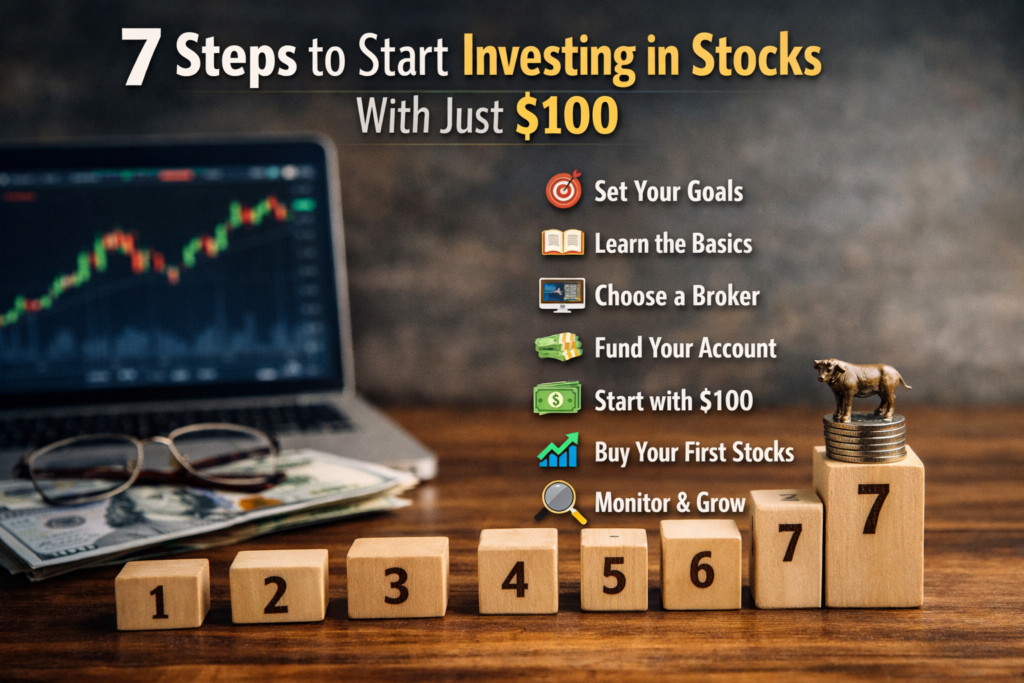
This guide provides a complete roadmap for transforming your first $100 into the foundation of long-term wealth. Whether you’re a college student, a recent graduate, or simply someone who wants to stop procrastinating, these seven steps will get you from zero to invested today.
The Power of Starting Small: A $100 monthly investment earning 10% annually grows to over $200,000 in 30 years. The key isn’t the amount—it’s the consistency and time.
Step 1: Build Your Safety Net First
Before buying a single stock, ensure you have a basic emergency fund. This isn’t technically an investment, but it’s the foundation that makes investing possible.
Why it matters: If you invest your last $100 and then face an unexpected expense—a flat tire, medical bill, or urgent repair you’ll be forced to sell your investments, possibly at a loss. According to The Motley Fool’s research, only 55% of Americans have enough saved to cover three months of expenses.
The solution: Keep your first $100 (or a portion of it) in a high-yield savings account. As of spring 2026, you can earn 3% or more on emergency savings so your money isn’t idle while you build security. Once you have a small cushion (aim for $500-$1,000 eventually), you’re ready to invest the rest.
Step 2: Choose the Right Brokerage Account
The second step is opening an investment account. The good news: it’s never been easier, and you can do it entirely on your phone in under 10 minutes.
Best Brokers for $100 Investors (2026)
Table:
| Broker | Minimum | Fractional Shares | Best Feature | Best For |
|---|---|---|---|---|
| Fidelity | $0 | Yes ($1 min) | 7,000+ stocks/ETFs, excellent research | Overall best choice |
| Charles Schwab | $0 | Yes ($5 min) | 500 S&P 500 Stock Slices | Buy-and-hold investors |
| Robinhood | $0 | Yes (1/1,000,000th) | Clean mobile app, IRA match | Beginners, mobile users |
| SoFi Active Investing | $0 | Yes ($5 min) | All-in-one banking + investing | Financial management |
| Webull | $0 | Yes ($5 min) | Advanced charting, high cash interest | Active traders |
All these platforms offer commission-free trading, meaning you keep 100% of your $100 working for you.
Pro tip: Download a few apps and explore their interfaces before funding. The best broker is the one you’ll actually use. You can always transfer accounts later as your needs evolve.
Step 3: Understand Fractional Shares
Fractional shares are the technology that makes $100 investing viable. Instead of buying whole shares (Amazon at $200, Tesla at $250), you buy a percentage of a share proportional to your investment.
How it works: Invest $100 in a $500 stock, and you own 0.2 shares. The stock rises 10%, your investment rises 10%. You receive proportional dividends. You can sell your fractional share during market hours just like a whole share.
Top Brokers for Fractional Shares
- Fidelity: “Stocks by the Slice” 7,000+ stocks and ETFs from $1, automatic dividend reinvestment
- Charles Schwab: “Stock Slices” buy up to 30 S&P 500 companies at once for $5 each
- Robinhood: Buy as little as one-millionth of a share, thousands of eligible stocks and ETFs
- Interactive Brokers: 10,500+ stocks and ETFs, professional-grade platform
Key benefit: Fractional shares ensure every dollar is invested. No leftover cash sitting idle because you couldn’t afford another whole share.
Step 4: Decide Between ETFs and Individual Stocks
With $100, you face a strategic choice: broad diversification through ETFs, or concentrated bets on individual companies.
The Case for ETFs (Recommended for Beginners)
ETFs (Exchange-Traded Funds) bundle hundreds or thousands of stocks into a single purchase. With $100, you can buy:
- VOO or SPY: S&P 500 index funds own a piece of America’s 500 largest companies
- VTI: Total U.S. stock market exposure to thousands of companies
- VXUS: International stocks geographic diversification
Why ETFs win for beginners:
- Instant diversification one purchase spreads risk across hundreds of companies
- Lower volatility than individual stocks
- Professional management with minimal fees (some as low as 0.03% annually)
- Warren Buffett’s recommendation for most investors
The Case for Individual Stocks
If you want to own specific companies you believe in, fractional shares make this possible. A balanced approach for $100:
- 70% in broad market ETF (foundation)
- 30% in 1-2 individual stocks (companies you know and use)
This builds diversification while letting you learn stock analysis.
Step 5: Execute Your First Trade
Once your account is funded with $100, it’s time to invest. Here’s the practical process:
For ETF Purchase:
- Search for your chosen ETF (e.g., “VOO” for Vanguard S&P 500)
- Select “Buy” and enter the dollar amount ($100 or your chosen allocation)
- Choose order type: “Market order” executes immediately at current price; “Limit order” sets your maximum price
- Review and confirm
For Fractional Stock Purchase:
- Search for the company (e.g., “AAPL” for Apple)
- Select “Buy in Dollars” (not shares)
- Enter your investment amount
- Confirm purchase
Timing tip: The stock market is open Monday-Friday, 9:30 AM to 4:00 PM ET. You can place orders outside these hours, but they’ll execute when the market opens.
Step 6: Set Up Automatic Investing
The most powerful feature for small investors isn’t stock picking it’s automation. Set up recurring investments so you never miss a contribution.
How to automate:
- Link your bank account for automatic transfers
- Set weekly or monthly investments (even $25/week adds up to $1,300/year)
- Enable dividend reinvestment (DRIP) to compound growth automatically
- Use robo-advisors if you want hands-off management
Robo-advisor option: If analyzing investments feels overwhelming, platforms like Betterment, Acorns, or SoFi’s automated investing will build and manage a portfolio for you based on your goals and risk tolerance. Most charge under 0.25% annually about $0.25 per $100 invested.
The math: $100/month invested at 10% average annual return grows to $200,000+ over 30 years. Automation makes this effortless.
Step 7: Adopt the Long-Term Mindset
Your $100 investment won’t make you rich overnight. But it starts a habit that will.
Critical principles:
- Time in market beats timing the market: Don’t try to predict highs and lows. Consistent investing wins.
- Ignore daily fluctuations: The market will be up some days, down others. Check your portfolio monthly, not hourly.
- Reinvest everything: Dividends and gains should compound, not get withdrawn.
- Increase contributions over time: As your income grows, scale up your investments. $100 becomes $200, then $500.
Historical context: The stock market averages approximately 10% annual returns over decades. Some years you’ll see 20% gains; others, 20% losses. The key is staying invested through the cycles.
What to Avoid With Your First $100
❌ Day Trading
Attempting to buy and sell quickly for profits is statistically a losing game for beginners. It requires expertise, time, and tolerance for losses.
❌ Penny Stocks
Stocks under $5 often represent failing companies or scams. The low price is tempting, but the risk of total loss is high.
❌ Meme Stocks
Social media hype doesn’t equal sound investment. GameStop and AMC made headlines, but most meme stock investors lost money.
❌ High-Fee Products
Avoid mutual funds with 5% “load fees” or investment products with complex cost structures. Stick to commission-free ETFs and stocks.
❌ Borrowing to Invest
Never use margin (borrowed money) when starting out. The potential losses exceed any possible gains.
Sample $100 Portfolios for Different Goals
The Conservative Beginner (Low Risk)
- 70% VOO (S&P 500 ETF)
- 30% BND (Total Bond Market ETF) Focus: Stability with modest growth
The Growth Seeker (Moderate Risk)
- 60% VTI (Total U.S. Stock Market)
- 20% VXUS (International Stocks)
- 20% Individual stock (company you know well) Focus: Maximum long-term growth
The Tech Enthusiast (Higher Risk)
- 50% QQQ (Nasdaq-100 Tech ETF)
- 30% VOO (S&P 500)
- 20% Fractional shares (Apple, Microsoft, or Nvidia) Focus: Technology sector exposure
Your Next Steps: From $100 to Financial Freedom
Starting with $100 isn’t about getting rich quick it’s about building the systems and habits that create wealth over time. Here’s your action plan for the next 30 days:
Week 1: Open your brokerage account and fund it with $100 Week 2: Make your first investment (ETF recommended) Week 3: Set up automatic recurring investments ($25/week or $100/month) Week 4: Enable dividend reinvestment and review your portfolio
In one month, you’ll have transformed from a non-investor to someone with a growing portfolio, automated contributions, and a foundation for long-term wealth.
The stock market doesn’t care if you start with $100 or $100,000. What matters is that you start. Time is your greatest asset put it to work today.
Ready to Start Investing?
Download our First $100 Investment Checklist with broker comparisons, ETF recommendations, and setup instructions.
Subscribe to Dorta & Co. Finance for weekly investing tips and market insights.
Disclaimer: This article is for educational purposes only and does not constitute investment advice. All investments carry risk of loss. Past performance does not guarantee future results. Consult a qualified financial advisor for personalized guidance.
About the Author: Felipe Dorta is a Financial Content Editor at Dorta & Co. Finance, specializing in beginner investing strategies and personal finance education. Connect via LinkedIn or Telegram.