
By Felipe Dorta, Financial Content Editor
Last Updated: March 13, 2026 | Originally Published: March 13, 2026
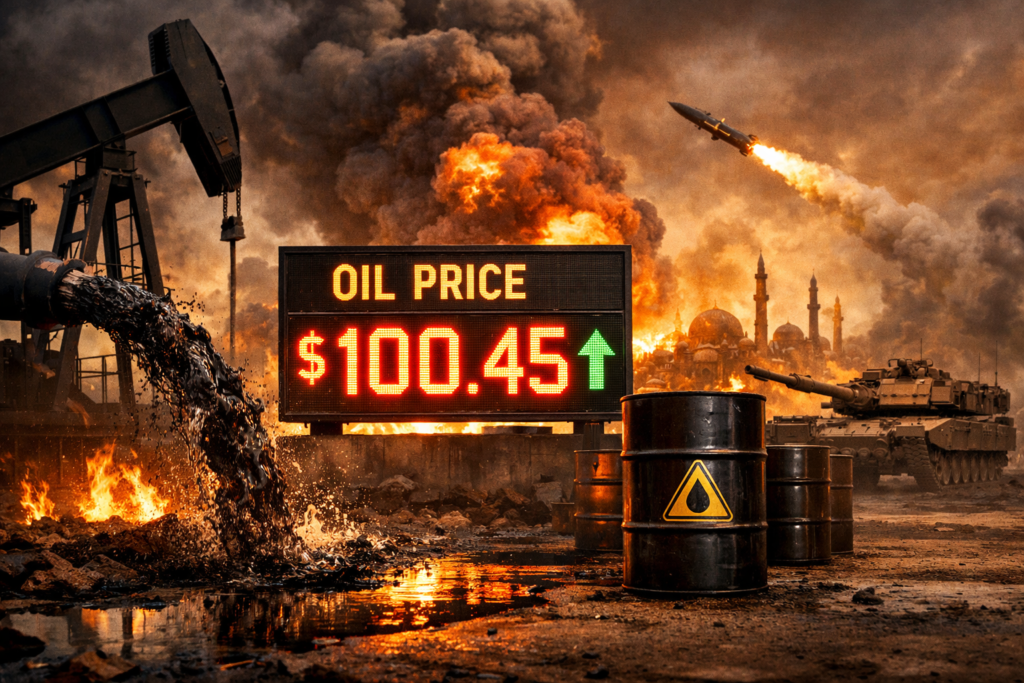
Brent crude oil shattered the $100 barrier on March 9, 2026, reaching $119.50 per barrel the highest level since the summer of 2022 as the U.S.-Israel war against Iran entered its second week. The 30% single-day surge marked the most extreme oil price volatility since the COVID-19 pandemic, triggered by Iran’s effective closure of the Strait of Hormuz and coordinated attacks on energy infrastructure across the Persian Gulf.
The psychological threshold of $100 oil, breached for the first time since Russia’s invasion of Ukraine, signals a fundamental shift in global energy markets. With approximately 20 million barrels of daily oil supply roughly 20% of global consumption now blocked at the world’s most critical maritime chokepoint, economists are warning of potential stagflation, supply chain collapse, and a cascading crisis extending far beyond energy markets.
Historic Context: “In economic terms, this is already the largest oil supply shock ever,” stated Nicholas Mulder, assistant professor of history at Cornell University. “We are seeing roughly three to four times as many barrels of oil lost as during the 1973 and 1979 oil crises.”
The Strait of Hormuz: The World’s Energy Lifeline
The Strait of Hormuz, a narrow 21-mile waterway separating Iran from Oman, handles more than just oil. This strategic passage facilitates:
- 20% of global oil consumption (approximately 20 million barrels daily)
- 20% of global LNG trade (critical for European and Asian energy security)
- 45% of global urea fertilizer supply (essential for agricultural production)
- Significant volumes of aluminum, critical minerals, and helium (vital for semiconductor manufacturing)
When Iran effectively closed this waterway on March 2, 2026, the impact was immediate and severe. By March 13, over 250 million barrels of oil had been blocked from reaching global markets creating what the International Energy Agency described as “the largest supply disruption in the history of the global oil market.”
Immediate Market Reaction
Table:
| Date | Brent Crude Price | Daily Change | Key Event |
|---|---|---|---|
| Feb 28, 2026 | $72.00 | — | Conflict begins |
| Mar 2, 2026 | $85.00 | +18% | Strait closure announced |
| Mar 9, 2026 | $119.50 | +30% | Peak intraday price |
| Mar 9, 2026 | $85.00 | -29% | Trump suggests war ending |
| Mar 13, 2026 | $101.15 | +9% weekly | Continued volatility |
The price swings reflect extreme uncertainty. When President Trump suggested the war was “very complete” on March 9, prices briefly collapsed 29% to $85. However, Iran’s new Supreme Leader Mojtaba Khamenei immediately vowed to continue fighting, and attacks on shipping resumed—sending prices back toward triple digits.
Supply Chain Cascades: Beyond Oil
The Hormuz closure extends far beyond crude oil, threatening global supply chains for essential commodities:
Fertilizer Crisis
Nearly half of global urea supply critical for agricultural fertilizer—originates from Gulf producers now unable to export. Canadian farmers report immediate price spikes, with spring planting season approaching. Rice University energy fellow Jim Krane warns: “It’s a critical node in the global economy and the loss of access to that single strait is just causing cascading effects across the global economy.”
Critical Minerals Shortage
Copper, nickel, and cobalt shipments from Gulf producers have halted, threatening semiconductor and electric vehicle manufacturing. Bahrain’s aluminum producer has already declared force majeure, suspending contractual deliveries.
LNG Supply Collapse
Qatar, the world’s second-largest LNG exporter, halted production and informed clients it cannot complete deliveries. This particularly impacts energy-dependent Asian markets, with South Korea imposing fuel price caps for the first time in 30 years and Bangladesh shutting universities to conserve power.
Aviation Industry Shock
Jet fuel prices have climbed 35% above pre-war levels. Global airlines have cancelled over 37,000 flights, with Deutsche Bank warning that financially weaker carriers face potential operational collapse. A Seoul-to-London flight on Korean Air jumped from $564 to $4,359 in one week.
Economic Impact: The Three Scenarios
Energy analysts have mapped three potential trajectories for oil markets, each with profound economic implications:
Table:
| Scenario | Probability | Oil Price Range | Economic Outcome |
|---|---|---|---|
| Quick Resolution | Low | $70-80 | Rapid normalization, minimal GDP impact |
| Protracted Conflict | High | $100-120 | Sustained inflation, 0.5-1% GDP drag |
| Regional Escalation | Medium | $150-200+ | Global recession, severe supply shortages |
Current Assessment: Goldman Sachs now expects Brent to average over $100 in March and $85 in April, with gradual easing to the low $70s by year-end assuming the disruption proves temporary. However, if the Strait remains closed for two months, their Q4 forecast jumps from $71 to $93 per barrel.
Oxford Economics projects that oil averaging $140 for just two months would reduce global real GDP by 0.7% by year-end 2026, with developing nations facing acute shortages and potential power outages already appearing in Pakistan and Bangladesh.
Policy Responses: Insufficient Against the Tide
Strategic Reserve Releases
The IEA’s coordinated release of 400 million barrels represents the largest such intervention in history. However, energy analyst Rory Johnston notes a critical limitation: “U.S. Energy Secretary Chris Wright has said it will take about 120 days for the American reserves to be deployed. That would mean about 1.4 million barrels per day to address a hole of about 250 million barrels that’s growing by the day.”
Pipeline Divertsions
Saudi Arabia’s East-West Pipeline can transport 5 million bpd to bypass Hormuz, though historically it has rarely exceeded 2.5 million bpd. The UAE’s Habshan-Fujairah Pipeline adds 1.5 million bpd capacity. Combined, these alternatives replace less than 20% of normal Hormuz flows.
Diplomatic Efforts
The G7 finance ministers discussed coordinated reserve releases but decided against immediate action on March 9. President Trump has alternated between threatening Iran with “unlimited ammunition” and suggesting diplomatic resolution, creating policy uncertainty that exacerbates market volatility.
Industry Sector Impact Analysis
Energy Sector Winners
Integrated oil majors (Chevron, Exxon Mobil, BP, Shell) benefit from higher prices while maintaining diversified supply chains. U.S. shale producers with domestic operations face minimal Hormuz exposure. However, companies with significant Middle East production (Saudi Aramco, Kuwait Oil) face operational disruptions despite price gains.
Transportation Crisis
Airlines face existential pressure from jet fuel costs, with global carriers implementing emergency fuel surcharges and route cancellations. Shipping companies confront doubled insurance premiums for Gulf transit, with many vessels rerouting around Africa—adding weeks to delivery times and consuming additional fuel.
Manufacturing Disruption
Petrochemical-dependent industries (plastics, synthetic materials) face feedstock cost explosions. Semiconductor manufacturers confront helium shortages critical for chip production. Agricultural sectors worldwide brace for fertilizer price spikes affecting 2026 harvest yields.
Consumer Impact
Goldman Sachs estimates each 10% oil price increase adds 0.2 percentage points to U.S. inflation. With Brent up 40% from pre-war levels, this implies 0.8% additional inflation compounding existing price pressures and potentially forcing the Federal Reserve to maintain higher interest rates longer than planned.
Geopolitical Dynamics: No Clear Exit
The conflict’s trajectory remains highly uncertain. Iran’s Revolutionary Guard Corps (IRGC) spokesperson Ebrahim Zolfaqari explicitly threatened: “Get ready for oil to be $200 a barrel, because the oil price depends on regional security, which you have destabilised.”
Iran has demonstrated sophisticated military capabilities, disabling U.S. radar and advanced warning systems while continuing missile and drone attacks on shipping and facilities. Unlike previous conflicts, Iran possesses the domestic industrial capacity to sustain prolonged resistance—suggesting the Hormuz closure could extend for weeks or months rather than days.
Cornell University’s Nicholas Mulder emphasizes the unprecedented nature of this crisis: “As Gulf producers reduce output and shut down production, we are seeing roughly three to four times as many barrels of oil lost as during the 1973 and 1979 oil crises.”
Former IEA head Neil Atkinson warns: “Unless something changes very soon, we are in a potentially game-changing and unprecedented energy crisis… The sky is the limit” for oil prices if the Strait remains closed.
Investment Implications: Navigating Volatility
Defensive Positioning
- Energy infrastructure with minimal Hormuz exposure (U.S. shale, Canadian oil sands, Brazilian pre-salt)
- Renewable energy beneficiaries from accelerated transition incentives
- Gold and precious metals as inflation hedges (already trading near $5,190/oz)
- Short-duration Treasuries protecting against rate uncertainty
Risk Avoidance
- Airlines and shipping with high fuel cost sensitivity
- Emerging market debt vulnerable to dollar strength and import costs
- Petrochemical-dependent manufacturers facing margin compression
- European industrial stocks exposed to LNG supply disruption
Tactical Opportunities
- Energy storage and pipeline companies benefiting from supply chain restructuring
- Fertilizer alternatives (bio-fertilizers, precision agriculture technologies)
- Domestic logistics providers as global shipping reroutes
Conclusion: A New Energy Era
The $100 oil threshold represents more than a price point—it signals a fundamental reassessment of geopolitical risk in global energy markets. The era of assuming free flow of Middle East oil has ended, potentially permanently.
For investors, policymakers, and consumers, three realities now dominate:
- Supply Security Trumps Cost: Nations will prioritize energy independence over price optimization, accelerating renewable transitions and strategic reserve accumulation
- Volatility Is the New Normal: Even if the immediate crisis resolves, the demonstrated vulnerability of Hormuz ensures permanent risk premiums in oil prices
- Cascading Effects Are Non-Linear: From fertilizer to semiconductors, the interconnected global economy cannot absorb 20% supply disruptions in critical nodes without systemic stress
The IEA’s 400 million barrel release provides temporary relief but cannot resolve structural vulnerabilities. As energy analyst Johnston concludes: “Fundamentally, the normal flow of traffic through the strait must resume or the oil market will break the global economy.”
Whether that resumption comes through diplomatic resolution, military escalation, or regime change in Tehran remains the critical uncertainty determining whether oil stabilizes at $80 or explodes toward $200. For markets, the only certainty is that energy security has reclaimed its position as the primary driver of global economic stability.
Market Data Summary (As of March 13, 2026)
Table:
| Indicator | Current Level | Change from Feb 28 |
|---|---|---|
| Brent Crude | $101.15 | +40.5% |
| WTI Crude | $95.87 | +45.6% |
| Strait of Hormuz Traffic | Effectively Closed | -100% |
| Global Oil Supply Disrupted | 20 million bpd | -20% |
| IEA Reserve Release | 400 million barrels | Historic largest |
| Gold Price | $5,190/oz | +8.2% |
| VIX (Fear Index) | 28.4 | +67% |
Sources: CNBC, Reuters, Bloomberg, International Energy Agency, Rystad Energy
Download our Family Travel Planning – Spreadsheet 8 Templates of Excel/Sheets Spreadsheets Vacation Organizer Bundle.
Subscribe to Dorta & Co. Finance for breaking analysis on energy markets and geopolitical risk.
Disclaimer: This article is for educational purposes only and does not constitute investment advice. Energy markets are highly volatile and subject to rapid change based on geopolitical developments. Consult qualified financial advisors before making investment decisions.
About the Author: Felipe Dorta is a Financial Content Editor at Dorta & Co. Finance, specializing in energy markets and geopolitical economic analysis. Connect via LinkedIn or Telegram.