
Investment Returns Calculator: Plan Your Portfolio Growth for 2026
Last Updated: March 26, 2026 | Reading Time: 8 minutes
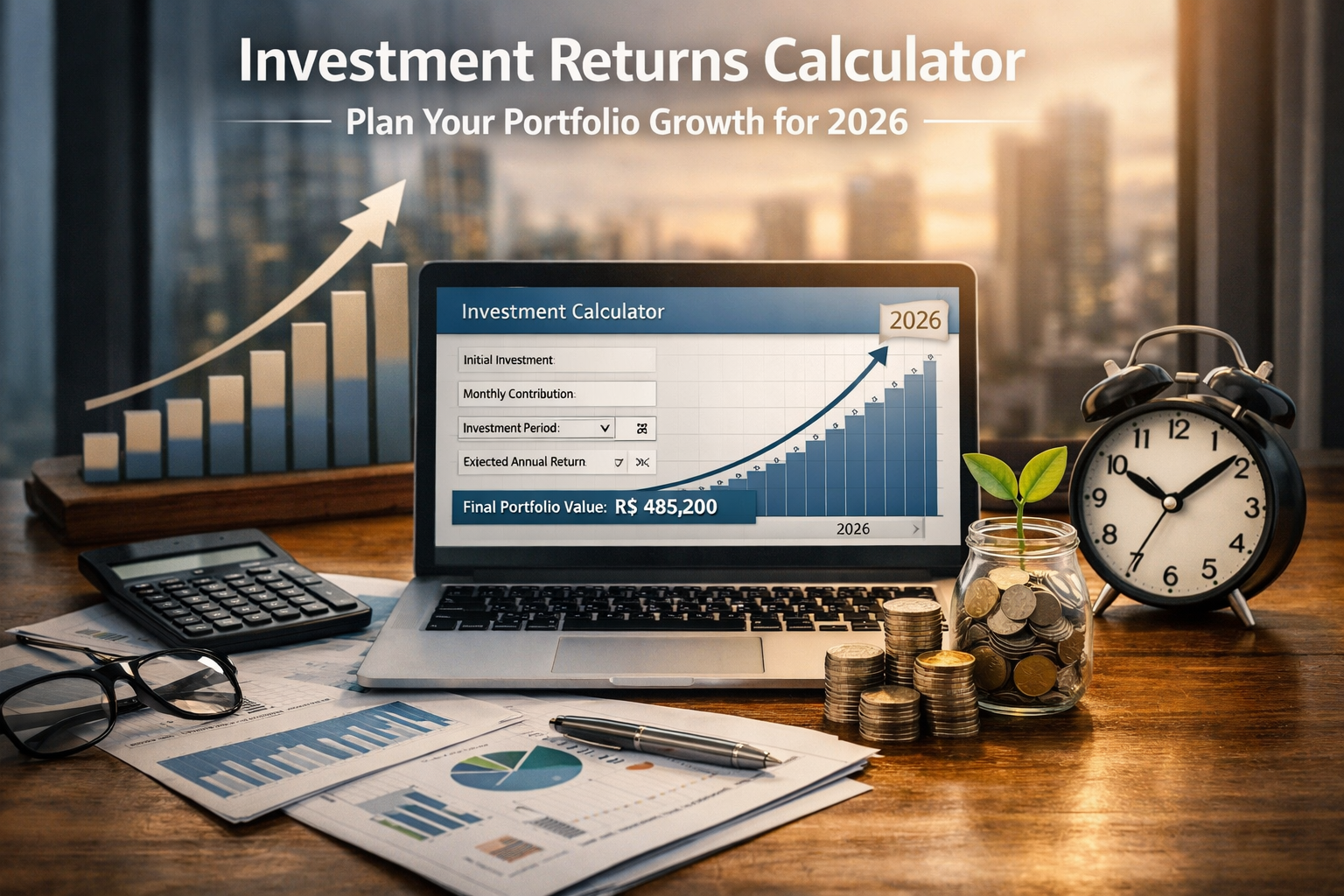
🎯 See Your Financial Future in Numbers
What if you could predict your wealth five, ten, or twenty years from now? Not with a crystal ball, but with cold, hard mathematics. Compound interest is the most powerful force in finance, yet most investors never run the numbers.
Small changes today create massive differences tomorrow. Increasing your monthly contribution by just $100, or improving your return by 2%, can mean the difference between a comfortable retirement and financial stress. But you will never know unless you calculate.
This is where most financial planning falls apart. People set vague goals like “save more” or “retire early” without ever quantifying what those words actually mean. Our calculator fixes that. Input your numbers, adjust the variables, and watch your future wealth appear in real time.
🧮 Your 2026 Investment Calculator
Compound Growth Calculator
Project your portfolio value through 2026 and beyond
📊 2026 Market Projections at a Glance
Historical Market Average
2026 401(k) Max (50+)
Recommended Savings Rate
2026 Inflation Estimate
🎯 How to Use This Calculator Effectively
The calculator above is not just a toy. It is a planning weapon. But like any tool, its value depends on how you use it. Here is how sophisticated investors leverage these projections.
✅ Scenario 1: The Baseline Reality Check
Start with your current situation. Input what you have saved now, what you realistically contribute monthly, and use a conservative 6% return. This is your baseline. If the number at the end shocks you in a bad way, you have identified your first problem.
✅ Scenario 2: The Optimization Game
Now adjust. What happens if you increase your monthly contribution by $200? What if you improve your return by 2% through better asset allocation? Small tweaks often reveal six figure differences over decades.
✅ Scenario 3: The Stress Test
Markets do not move in straight lines. Drop your expected return to 4% or increase your timeline by five years. How does your plan hold up? If it crumbles, your strategy is too fragile.
📈 2026 Investment Strategies by Age
Your calculator inputs should change based on where you are in life. A 25 year old and a 55 year old should not use the same assumptions.
🎓 In Your 20s: Aggressive Growth Mode
Time is your superpower. Use 9% to 11% expected returns in your calculator. Max out Roth contributions. Your goal is accumulation, not preservation. A 25 year old investing $500 monthly at 10% will have $2.8 million by 65. Start now.
🏢 In Your 30s and 40s: Balance and Catch Up
Use 7% to 9% returns. If you started late, increase contributions aggressively. This is peak earning years. Every dollar invested now is worth three dollars in retirement. Check your calculator monthly to stay motivated.
🌴 In Your 50s and Beyond: Preservation with Growth
Shift to 6% to 8% projections. Focus on catch up contributions. The calculator becomes a reality check for retirement dates. If the math does not work, you know you need to delay retirement or reduce lifestyle expectations.
⚠️ Calculator Mistakes That Cost You Thousands
Garbage in, garbage out. Here are the most dangerous errors people make when projecting their wealth.
🚫 Error 1: Overestimating Returns
Everyone thinks they will beat the market. Data shows 90% of active managers underperform index funds over 15 years. Use historical averages, not your fantasy returns.
🚫 Error 2: Ignoring Inflation
Your calculator shows $1 million. Great! Except in 30 years, that buys what $400,000 buys today. Always subtract 2% to 3% from your projected returns to see real purchasing power.
🚫 Error 3: Inconsistent Contributions
Life happens. You skip months. You withdraw for emergencies. Your calculator assumes perfect discipline. Build a 20% buffer into your projections for reality.
🚫 Error 4: Forgetting Taxes
Tax deferred accounts like 401(k)s and IRAs help, but eventually taxes come due. Roth accounts grow tax free. Taxable accounts face annual drag. Adjust expectations accordingly.
🎓 Frequently Asked Questions
How do I calculate investment returns for 2026?
To calculate investment returns for 2026, use the compound interest formula: A = P(1 + r)^t + PMT × [((1 + r)^t – 1) / r], where P represents your initial investment, r is the monthly interest rate, t is the number of months, and PMT is your monthly contribution. Our free calculator automates this complex math, providing instant projections with visual breakdowns of total invested versus interest earned.
What is a realistic return rate for 2026?
Historical stock market data suggests 7% to 10% annual returns for diversified portfolios over long periods. However, 2026 projections should account for current economic conditions. Conservative financial planners typically use 6% to 8% for projections, while aggressive growth investors might use 10% to 12%. Always adjust for inflation by subtracting 2% to 3% to determine your real return.
How much should I invest monthly to reach $1 million?
Using the calculator, a 30 year old aiming for $1 million by age 65 needs to invest approximately $485 monthly at 8% annual returns. Start at age 40? That jumps to $1,200 monthly. At age 50? You need $3,200 monthly. Time is the critical variable. The earlier you start, the less painful the monthly requirement.
Should I include my employer 401(k) match in calculations?
Absolutely. An employer match is free money that instantly boosts your return. If your employer matches 50% up to 6% of salary, that is an immediate 50% return on those contributions. Always include this in your monthly contribution input, and prioritize getting the full match before any other investing.
How do taxes affect my investment calculations?
Taxes significantly impact long term growth. Traditional 401(k)s and IRAs provide tax deferred growth but face ordinary income tax on withdrawals. Roth accounts grow completely tax free. Taxable brokerage accounts face annual dividend and capital gains taxes, creating a drag of approximately 0.5% to 1% annually. Use tax advantaged accounts first, and adjust taxable account projections downward by 1% to account for tax drag.
🚀 Your Numbers Do Not Lie
Hope is not a strategy. Wishful thinking does not compound. The only way to build serious wealth is to quantify your path and stick to it.
Our calculator removes the guesswork. It shows you exactly where current habits lead. If you do not like the destination, change the inputs. Increase contributions. Improve returns through education. Extend your timeline. You control the variables.
The 10% who retire wealthy are not luckier than everyone else. They are just the ones who ran the math early, believed what it told them, and adjusted their behavior accordingly.
Run your numbers now. Then run them again next month. And the month after. Awareness precedes improvement.
What did your calculation reveal? Share your target number in the comments and let us know what adjustments you are making to reach it.
Educational Content Notice
This article and calculator are for educational and informational purposes only. They do not constitute financial, investment, or tax advice. All projections are hypothetical and based on user inputs. Actual investment returns will vary and may result in loss of principal. Past performance does not guarantee future results.
⚡ Consult a fee-only fiduciary financial advisor for personalized guidance.
FTC Disclosure Compliance
In compliance with FTC guidelines: (1) We are not financial advisors or investment professionals; (2) This content is educational, not personalized advice; (3) We may receive compensation from advertisements displayed; (4) Calculator results are projections, not guarantees; (5) All investment involves risk including possible loss of principal; (6) Consult qualified professionals before making financial decisions.
© 2026 Dorta & Co. Finance. All rights reserved.
Tags: investment calculator, compound interest, portfolio growth, 2026 financial planning, retirement calculator, wealth building, savings goals, investment returns